
Since Victoria 3 has been out for over half a year now, gone through three major updates, and gotten a DLC, I think it’s about time I finally did a review. We’ve also recently passed Victoria Day here in Canada, which isn’t really relevant to the review, but kind made me get my butt in order. Before we start I’ll say that this will be a short review, and more a simple game explanation, because the game came out October 25, and there are a lot of better reviews out there, especially since this is the first time I’ve played the series and am fumbling around with it a bit. I’ll also be reviewing the game as it was in version 1.2 (when I last played), even though 1.3 was recently released. So, some things may not be of full relevance.
Victoria 3 is a grand strategy game created by Paradox Interactive, but it isn’t your typical Paradox game. In most of their grand strategy games, war is a pretty big deal. Even the ones that aren’t map painters, using your beautiful casus bellis will really help you move forward. And while war is most certainly a thing in Victoria 3, the Victorian era did see a lot of shooting, after all, it’s not going to be your main concern. Instead of looking outwards for land, you’re going to be looking outward for money. Victoria 3 is a game about economy.
Victoria 3 is a game about economy, and a game about balancing–which an economy obviously needs. You have a big list of goods, and groups of people, or “pops”, that will be using those goods. If you don’t have enough of something in your economy, they’ll be paying more than the base price of that item. They won’t be happy about that, especially for staple goods–the ones they need to survive. If you’re not producing enough grain in 1840, or at least don’t have enough in your economy through production and trade, people will have to pay more for it, basic supply/demand. They won’t be happy, especially the poor ones, because it turns out in the mid-19th century, bread is pretty important. They won’t, however, care that they can’t afford fancy stuff like meat, because that’s something they probably couldn’t have afforded anyway. That’s for the rich. So what do you do? Get more grain into your economy, because people are emigrating, and you need them around to work. Or, they stay in the country but become radicalized, and next thing you know: civil war. On the other side of the scale, you can’t have too much grain, or all the farms will start firing people or paying low wages. Start exporting it or building things that use it, or guess what? Radicalized. Civil war.

It’s not something you normally see in video games, but does it work? Yeah, I’d say so. And you can kind of figure it out, depending on whom you play, without much issue. So far I’ve only played as two different nations. The first was Sweden, literally only because it’s the first in the game’s list of suggested starting nations. That collapsed pretty fast–Prussia gets a bit angry if you take Germanic lands. The second was Prussia, which…may or may not have been to get rich selling opium to China (I’m evil, sorry). While the rest of the world saw me as some backwater country, it actually helped me learn the game a lot by not being rich. None of the other nations in the Middle East could do much against me, and I made sure to buddy up with Britain and Russia so they wouldn’t come at me. As I balanced relationships, I could look at myself and balance my economy. Money-wise (money actually isn’t really a huge factor in an economy game, and has a soft cap on it) I was always in the black, at least until the Raj started producing more opium than me around the 1890s. Since I always had money, I could always build buildings to produce more goods, which are the “real” economy of Victoria 3. Money is just there to pay for buildings’ construction, and for your armies, if you’re at war. Since I was in a “poor” nation (again, had cash coming out the wazoo), I could focus on balancing my goods. I wasn’t good–er, skilled–at it, although a lot of that came from that whole desert thing making it hard to produce things like grain and wood. I took decades to switch from wooden buildings to iron buildings because each time I built an iron mine I needed more wood for the building; about a 70-year cycle in a 100-year long game, even though I was the leading trade partner with every Middle Eastern nation, as well as a bit of north-west India and Arabia. Which is a really long way of saying that you can hide away to learn the game without much issue of someone conquering you, something I really like.
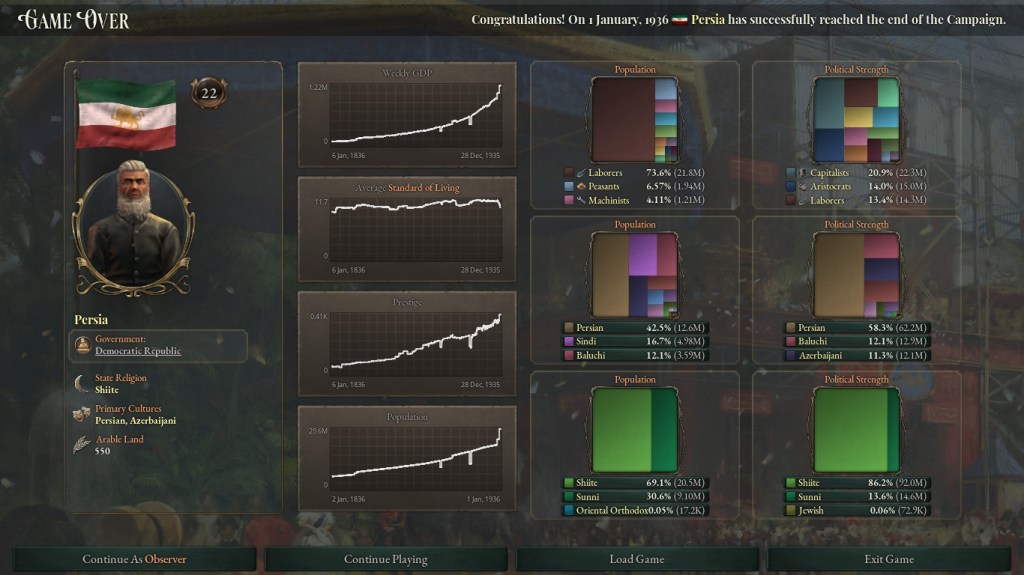
Okay, this is starting to get a bit too long for a short review, and a bit rambly, so I’m going to go with some things I don’t like. First off, data presentation. There are a lot of graphs in Victoria 3, but you can’t change the dates on them. GDP, for example, goes from the start date of the game to whenever you are now. Which is great for seeing how much better you’re doing; but the longer you go, the more zoomed out it gets. Sometimes you want to see the last decade, after you’ve made some big changes. On the other had, the graph for radicals and loyalists is really small. Since I was (and still am) learning, I had a hard time changing standard of living among pops, which is what creates radicals and loyalists. As a result, those short graphs were nearly parallel to the x-axis the whole game; it was going up and down, but it was hard to see. A longer time frame would have helped a lot. Having the ability to change the time frame would be a huge benefit to a game about economy, which turns out graphs are a big part of. Finally, sometimes you’ll see the line actually leave the graph. Generally this happens because of huge but short spikes in the price of an item. When you start producing cars, for example, the demand for and price of engines is going to skyrocket for a few weeks or months. But then the engine manufactures are going to start hiring people and creating product, which will drop the price back down. As annoying as this is, there’s probably no way to fix it without zooming the graph out so far you can’t actually read it, so it’s forgivable. I just wish the line would stop at the edge of the graph, instead of leaving it.
But the thing I dislike the most, and what the community as a whole seems to have the most grievance with, is war. As I mentioned before, Victoria 3 isn’t a war game, and because of that the war system is quote-unquote “simple”. But war, obviously, is still going to happen. Even if you try to play a peaceful game, an AI is probably going to drag you into something. How exactly does it work? Well, it’s kind of a dumbed-down version of the Hearts of Iron system. You pick a front line, and your army either attacks or defends. The biggest problem is that the army isn’t actually on the map, it just kind of exists in imagination of the battle system. This means that you have no direct control, and can’t go for what you want. In the 1.2 update they did let you tell your army where to go, which was a big improvement, but it’s still semi-random what land you capture. Sometimes you’ll suddenly get broken up into two separate battle lines because a state got split in half by the land you took. The AI is also way too eager to go to war on the defence, another thing that’s been slightly but not fully fixed, when they should really just back down from the start. Same outcome, but fewer lost resources. Finally, you can’t stand an army down once they’ve been raised, and armies are expensive. Again, while money isn’t a huge factor in the game, it is still a factor, and wars can bankrupt you when they shouldn’t. This is especially annoying when you aren’t a primary belligerent. If your homelands aren’t in danger and won’t be in danger, you’re paying for an army that’s not doing anything.
So, should you get Victoria 3? That depends. Do you really like Paradox and/or grand strategy games? You might like it, but maybe check out a let’s play of it first. If you’re not a big grand strategy fan, however, this isn’t a game for you, and it’s not the game you should play to get into the genre. I like it, but it’s probably on the bottom of my (played) Paradox list. Maybe second from the bottom; I like it more than Hearts of Iron 4, but that’s just because I suck at HoI, which I recognize is a better game. The good news is that it’s staying in Paradox’s view, unlike Imperator: Rome (not on my Paradox list), and will probably get better and more balanced as time goes on. So, maybe, in the future, it will be worth getting for people who aren’t really into the genre. But for now, if you’re wanting to get a new grand strategy game, Victoria 3 isn’t the way to go.
Have you played Victoria 3? Do you like it? Tell us in the comments below, or on Facebook or Twitter!
 novusgaming.net